Field guide · Backstage
The 45-Second Quick Change
A backstage change does not fail because someone was slow. It fails because of a decision made three hours earlier, in a hotel room, about how the bag was packed.
9 min read · Updated for the current competition season
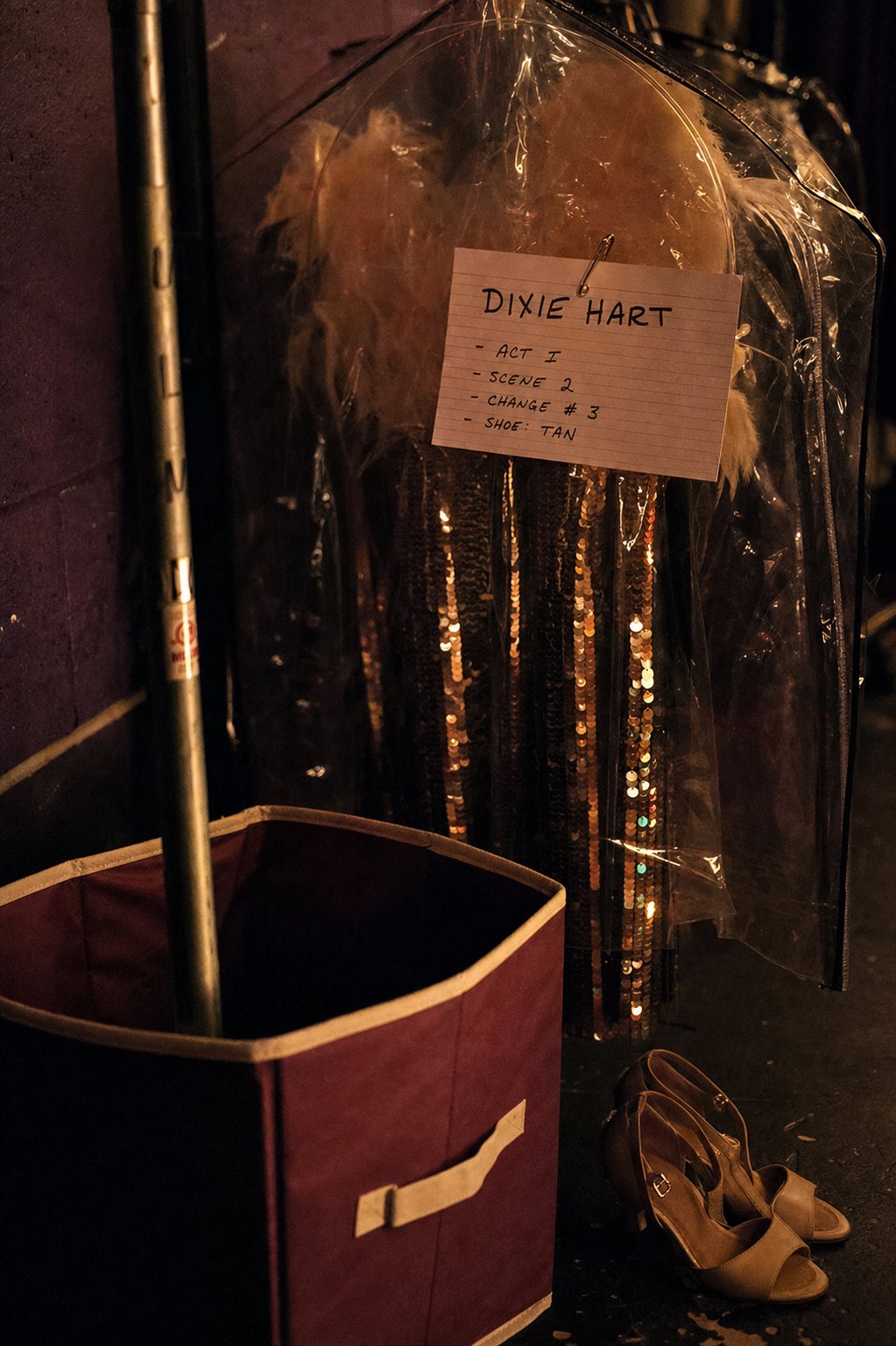
Most parents meet their first real quick change by accident. You are standing in a corridor you are not technically allowed to be in, holding a hanger, and someone in a headset says a number that is smaller than the number you were expecting. Your dancer comes off stage still breathing hard. There is no mirror, the light is bad, and a costume with fourteen hooks is somewhere in a duffel bag on the floor.
The instinct in that moment is to move faster. Speed is almost never the variable. Watch enough of these and you notice that changes fail for four reasons, and none of the four is the act of changing clothes.
The four failure modes
1. The search. Time spent locating a piece rather than putting it on. This is the single largest loss in nearly every failed change, and it is entirely preventable. A zipped duffel with three costumes in it is a search problem wearing a bag.
2. The fastening. Anything that cannot be done alone, in bad light, in one pass: back zippers, hook-and-eye rows, halter ties, straps that have to be threaded. These have a fixed time cost you cannot compress on the day. You can only decide in advance who is doing them and from which side.
3. The feet. Shoe changes routinely take longer than costume changes and nobody plans for them. Laces, ribbons, and a foot that is now sweaty and does not want to go into a tight tap shoe.
4. The head. Hairpieces, headpieces, hats, ears, feathers. Small, easily dropped, always the thing that gets forgotten, and the one item an audience notices is missing.
Rank those by seconds lost across a real competition day and the search is usually more than half the total. Which means the fix does not happen backstage. It happens in the room the night before.
What forty-five seconds actually looks like
It helps to see the budget written out, because the number is smaller than it sounds:
- 0–5 seconds. Off stage, through the wing, to the station.
- 5–12 seconds. Out of the first costume.
- 12–30 seconds. Into the second costume, including fastenings.
- 30–38 seconds. Shoes off, shoes on.
- 38–45 seconds. Head, final check, back to the wings.
There is no slack in that. Not one second of it is available for looking for something. And the number is often not forty-five. With a fast-moving block it can be closer to twenty-five. So the only way to make the change survivable is to arrive with the searching already done.
Pre-staging: one station, one order, one direction
Pre-staging is the entire system. Five rules.
Claim a spot and never move it. The same corner, the same chair leg, all day, every day of the weekend. Your dancer should be able to find the station without looking up. Moving your setup between blocks is how families lose costumes.
The bin, not the bag. An open, rigid, shallow bin beats a duffel every time, because a duffel requires opening, digging, and holding. A bin requires reaching. If your studio allows a small rolling rack, better still, because costumes hang, nothing wrinkles, and everything is visible at a glance.
Lay it in performance order. Front to back, or top to bottom, in the order the routines run. Never alphabetically, never by colour, never by which one is prettiest. The order on the schedule is the only order that matters.
Assemble each costume as one unit. This is the part most people skip and it is the part that saves the most time. One costume means the leotard plus the tights rolled inside it, plus the hairpiece safety-pinned to the hanger or clipped to the bag, plus the correct shoes tied together and sitting directly underneath. When the change comes, one grab produces everything. Nothing is retrieved from a second location.
One direction of travel. There is a clean side and a finished side. Costumes that have been worn never go back where the unworn ones live, even for a second, even folded neatly. The moment those two populations mix you have reintroduced the search problem you spent all night eliminating.
The goal is not to change quickly. The goal is to arrive at the change with no decisions left to make.
The order of operations
Within the change itself, work bottom-up and inside-out. It sounds fussy until the one time you do it in the wrong order and have to take a leotard back off to fix a tight.
- Shoes off first, before anything else, while your dancer is still standing and still catching their breath. Feet are the slowest step and doing them first means they are never the thing that runs out of time.
- Tights next if they are changing, because a tight cannot go on over a costume.
- The body of the costume, stepped into rather than pulled over the head wherever the design allows it, because pulling over a finished competition hairstyle is how buns come out.
- Fastenings, done by one named adult from one side. Not by whoever is nearest.
- Shoes on.
- Head last, always. Hairpiece, headpiece, then a two-second look from the front.
Then the finished pieces go to the finished side, in one motion, and nobody tidies anything until the block is over.
The card that makes it repeatable
Write one card per change and pin it to the bag or the bin. Six lines, no more:
- Routine name and the block or time it runs
- What comes off
- What goes on
- Shoes
- Head
- Who is helping, by name
That last line does more work than the other five combined. Most genuinely bad backstage moments are not a costume problem, they are a diffusion-of-responsibility problem: three adults each assume another one has the hairpiece. Name the adult. One dancer, one change, one named person, written down.
Modifications that buy you seconds
Within whatever your studio and the competition rules allow, a few structural changes pay for themselves all season:
- A nude base layer. A well-fitting nude leotard or bodyliner under everything means a change can happen anywhere, in front of anyone, without an extra step and without a towel-holding ritual.
- Duplicate the small things. A second pair of tights, a second set of hairpins, a spare hairpiece. Moving one small item between three costumes is a guaranteed search event. Duplicates are cheap relative to the entry fee for the routine you are about to miss.
- Pre-set the tension. Laces and ribbons loosened to exactly the width the foot needs and no wider, so nothing has to be re-tied under pressure.
- Tape instead of re-pinning. Body tape for a strap that shifts, and a dedicated small tin for pins so they are never loose in a bag.
- Rehearse it twice. Once at home, with a timer, in the actual costumes, with the actual helper. The first time a family runs a change should never be in a hallway with a headset counting down.
When it goes wrong anyway
Sometimes it goes wrong anyway. A hook tears, a shoe goes missing, the block runs early. Two things are worth knowing in advance.
The first is that the dancer's only job in that moment is to walk out looking composed. Nothing that happens in the wings has to be visible from row H. Practising the walk-out matters as much as practising the change.
The second is that the adults' visible calm is part of the costume. A dancer who is thirty seconds late and steady will read as fine. A dancer who is on time and rattled will not. Whatever else the system does, its real output is a family that is not panicking in front of a twelve-year-old.
The one-page version
Everything above compresses onto a card you can laminate, and a bin layout you can set up once and reuse every weekend. If you would rather not build that yourself, it is the Quick-Change Command Kit: the pre-stage map, a printable card for each change, the helper assignment sheet, and the bag manifest, in a format you fill in once per routine and reuse all season.
And if you are here because the money side is the loud part right now, the season cost calculator is free and takes about two minutes.